
Every year, countless people pick up a guitar with excitement and enthusiasm. They imagine themselves playing their favorite songs, jamming with friends, or simply enjoying the satisfaction of making music.
Unfortunately, many of those same people become frustrated and quit within a few months.
Quick Answer
The biggest mistake new guitar players make is trying to learn everything at once. While it may feel productive, constantly switching between songs, techniques, and tutorials often creates confusion. Focusing on the right skills in the right order leads to faster progress and greater confidence.
Over the years, I’ve taught students of all ages and skill levels, and I’ve noticed a common pattern among beginners who struggle to make progress.
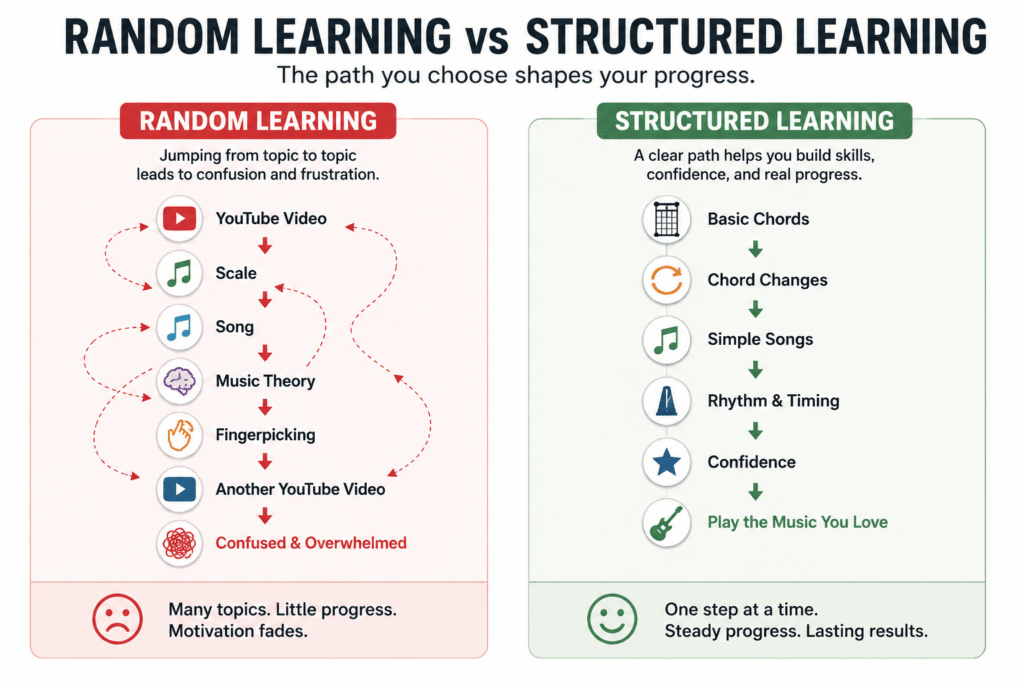
Surprisingly, the biggest mistake new guitar players make isn’t a lack of talent, poor technique, or not practicing enough. The biggest mistake is trying to learn too many things at once.
The Problem With Learning Everything
Today, there has never been more guitar information available. A beginner can open YouTube and instantly find thousands of videos covering:
At first, this seems like a good thing, but for many beginners, unlimited information creates unlimited distraction.
One day they’re learning a chord progression. The next day they’re trying to play a complicated solo. A few days later they’re watching a music theory lesson they don’t yet understand.
As a result, they spend a lot of time learning but very little time progressing.
Why Random Learning Doesn’t Work
Imagine trying to build a house without a blueprint. You buy windows before the foundation is poured. You start painting walls before the roof is installed. It would be confusing, inefficient, and frustrating.
Learning guitar works the same way. Certain skills build naturally on others.
For example:
When beginners jump randomly between topics, they often miss the natural sequence that helps skills develop more easily.
The “Shiny Object” Trap
Many students fall into what I call the “shiny object” trap. Every new video, exercise, or technique seems like the secret to getting better. Instead of mastering one skill, they constantly move on to something new.

This creates the illusion of progress.
You may feel productive because you’re learning new information every day, but information is not the same as skill.
Skill comes from repetition, application, and consistent practice. A student who works on chord changes for two weeks will usually make more progress than a student who spends those same two weeks jumping between ten different topics.
What Beginners Should Focus On Instead
Rather than trying to learn everything, beginners should focus on building a strong foundation.
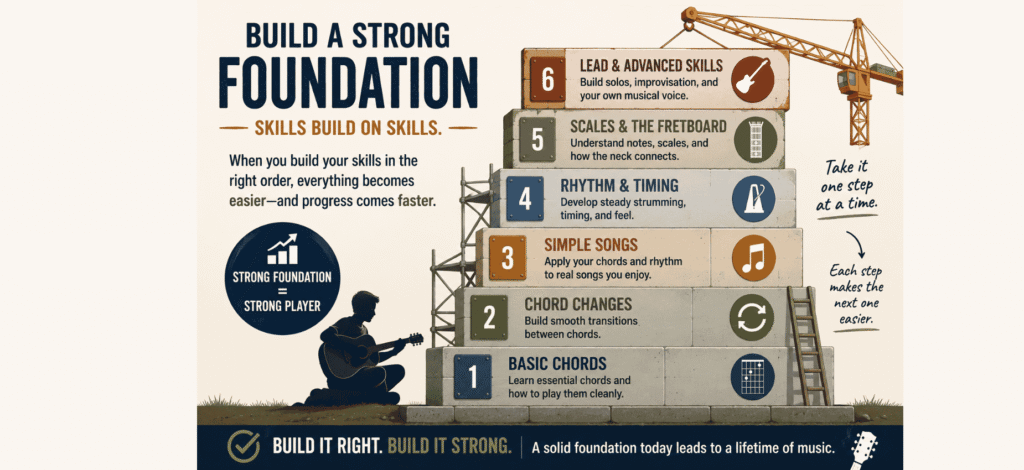
The exact path will vary from student to student, but most successful beginners spend their early months working on:
These may not seem exciting compared to advanced techniques, but they are the building blocks that make everything else easier later.
A strong foundation creates faster long-term progress.
Progress Is Often Boring Before It’s Exciting
One of the hardest things for beginners to accept is that improvement often happens gradually.
Many students expect dramatic breakthroughs.
Instead, progress usually looks like:
These small improvements may not seem impressive in the moment, but they add up over time.
The students who eventually become confident guitar players are usually the ones who learn to appreciate steady progress rather than chasing shortcuts.
The Value of a Learning Path
One of the reasons structured learning works so well is that it removes uncertainty.
Instead of asking: “What should I learn next?”, you already know your next step.
That clarity allows you to focus your energy on practicing rather than constantly searching for new information.
Whether you learn through a teacher, a method book, or another structured approach, having a clear learning path can help you avoid many of the frustrations that cause beginners to give up.
Consistency Beats Complexity
Another common misconception is that successful guitar players practice complicated exercises for hours every day. In reality, consistency is often far more important than complexity.
A student who practices focused material for 15–20 minutes each day will usually make better progress than someone who practices sporadically for long periods.
Small, consistent efforts create momentum. Momentum creates progress. Progress creates motivation.

Final Thoughts
The biggest mistake new guitar players make is trying to learn too much at once. While it’s tempting to jump between songs, techniques, videos, and exercises, that approach often leads to confusion and frustration.
Instead, focus on building a solid foundation, following a clear learning path, and making steady progress one step at a time.
Remember, learning guitar isn’t a race to see how quickly you can master every technique. It’s a journey of developing skills, building confidence, and learning to make music.
The players who succeed aren’t usually the ones who learn the fastest. They’re the ones who stay focused, stay patient, and keep moving forward.
About the Author
Daryl is the creator of the FretSteps Guitar Method and has over 25 years of playing and teaching experience. He helps beginner and developing guitar players learn through a structured, step-by-step approach designed to build confidence and lasting musical skills.