
One of the most common questions I hear from beginner and returning guitar players is:
“If there are thousands of free guitar lessons on YouTube, why do I still feel stuck?”
It’s a fair question.
Today, you can learn almost anything online. There are excellent guitar teachers creating valuable content, and many students have learned useful skills from videos. The problem is not YouTube itself. The problem is that most students end up learning from dozens of different videos without any clear direction.
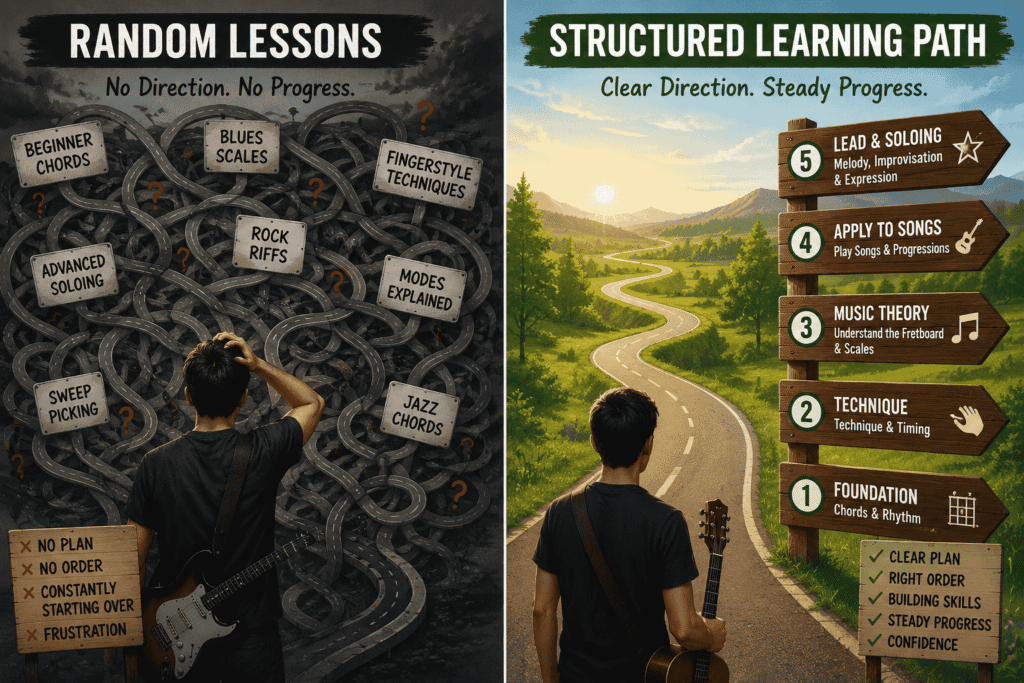
After more than 40 years of teaching guitar, I’ve noticed a pattern. Students who jump from one random lesson to another often work hard but struggle to build consistent progress. Meanwhile, students who follow a structured learning path tend to develop stronger skills and greater confidence over time.
Let’s look at why that happens.
Information Is Not the Same as Learning
One of the biggest misconceptions about learning guitar is believing that more information automatically leads to more progress.
A student watches a video about beginner chords. The next day they watch a lesson on blues scales. Then they find a video about fingerstyle guitar. A few days later they’re learning a rock riff that requires techniques they’ve never practiced before.
Each lesson may be good on its own. The problem is that the lessons are disconnected.
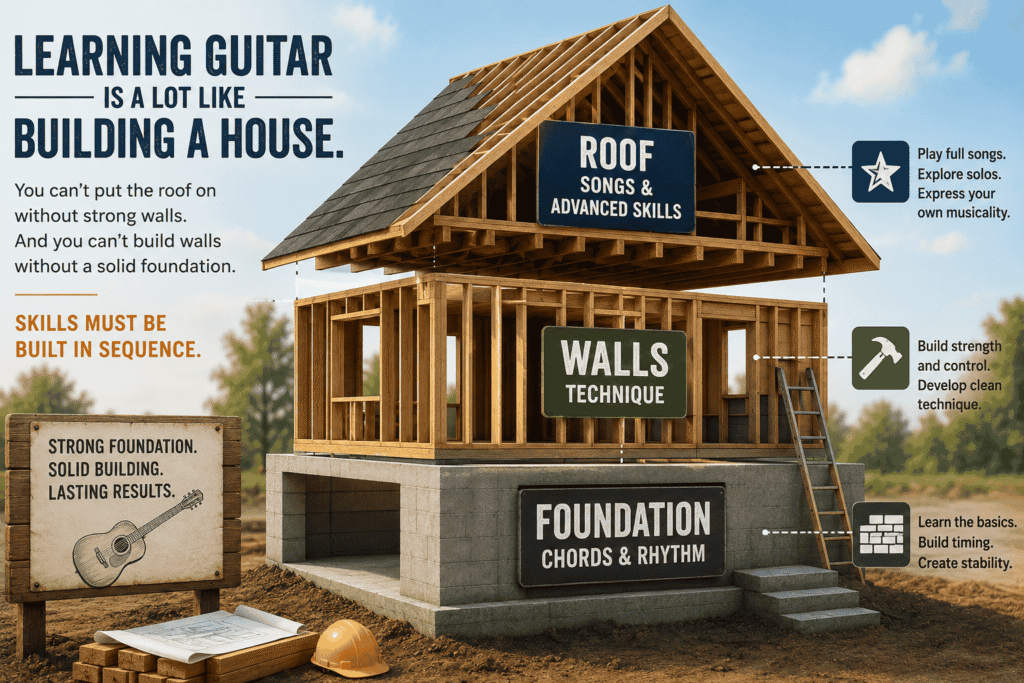
Learning guitar is a lot like building a house. Before you put up the roof, you need walls. Before you build walls, you need a foundation.
Skills on guitar work the same way. Some abilities naturally support and prepare you for others. When lessons are taken in a random order, students often develop gaps in their understanding without realizing it.
The Hidden Cost of Constantly Starting Over
Many online videos are designed to grab attention quickly.
You might see titles such as:
The issue isn’t necessarily the content. It’s that each video often introduces a completely new topic.
As a teacher, I’ve seen students spend months learning the beginnings of dozens of skills but never practicing any of them long enough to become comfortable. Real progress comes from repetition and reinforcement.
For example, learning three chords isn’t the difficult part. Learning to switch between them smoothly while keeping a steady rhythm is where the real growth happens.
That kind of improvement usually doesn’t happen from watching another video. It happens from focused practice over time.
Skills Need to Connect Together
One challenge with random online learning is that students rarely understand how one skill connects to another.
A beginner may learn:
All useful skills, but they may not understand how those pieces fit together musically.
Experienced teachers spend a lot of time thinking about sequence. What should a student learn first? What should come next? Which skill prepares them for the next challenge?
When lessons are organized thoughtfully, each new concept builds on something the student already knows. That creates momentum.
When lessons are random, students often feel like they’re working hard but moving in circles.
Too Many Choices Can Create Frustration
This is something many adult learners don’t expect. Having unlimited learning options can actually make practicing harder.
Instead of sitting down and working on today’s goal, students spend twenty minutes searching for the “best” lesson. Then they watch several videos. Then they try a little bit of each idea. By the end of the practice session, very little focused practice has occurred.

Over the years, I’ve found that students make better use of their practice time when they know exactly what they’re working on.
A simple plan removes decision fatigue. Rather than asking: “What should I learn today?” The question becomes: “How can I improve the skill I’m currently working on?”
That shift makes a surprisingly big difference.
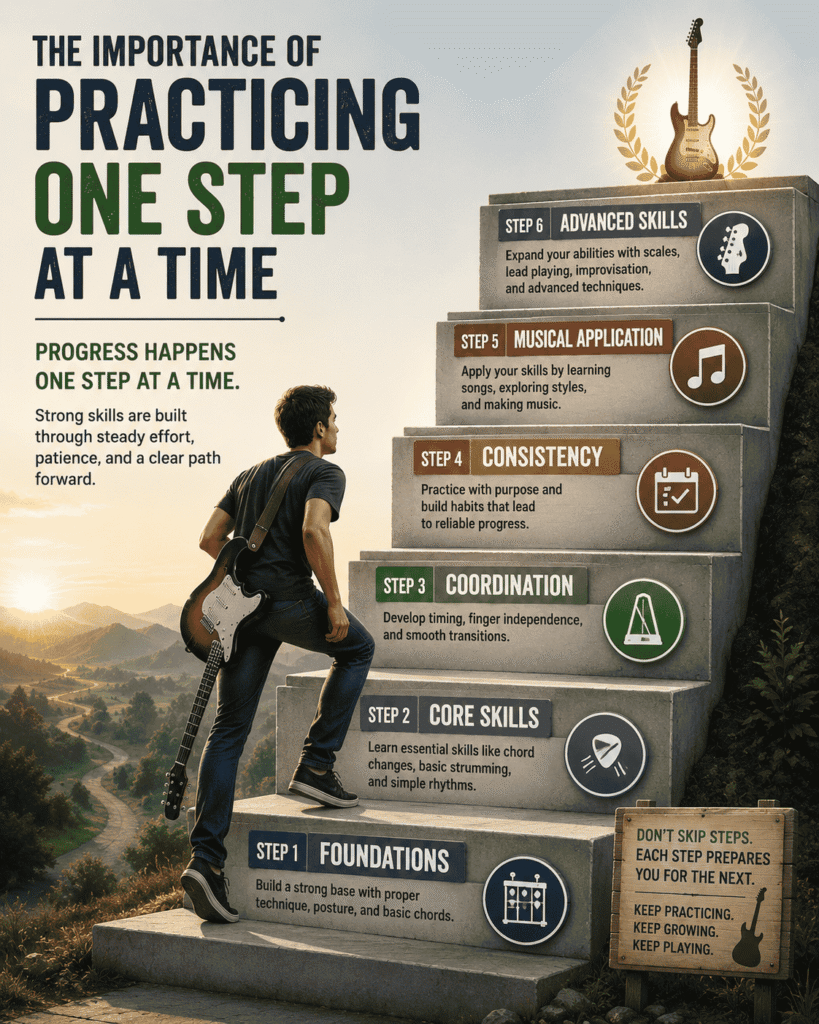
The Importance of Practicing One Step at a Time
One lesson I’ve learned from teaching hundreds of students is that most guitar problems are not caused by a lack of talent. They’re usually caused by trying to learn too many things at once.
Students often believe they need:
In reality, they often need more time with the skills they already know.
Strong guitar players aren’t necessarily the ones who learned the most information. They’re often the ones who mastered the fundamentals and continued building on them steadily.
Progress may sometimes feel slow, but steady progress creates a much stronger foundation than constantly chasing the next new lesson.
How to Use YouTube More Effectively
YouTube can still be an excellent learning tool when used wisely.
Here are a few guidelines I often give students:
Those skills never stop being important.
Final Thoughts
There is more guitar information available today than at any other point in history and that’s a wonderful opportunity. But information alone doesn’t create progress.
Over the years, I’ve watched many students become discouraged because they confused collecting lessons with developing skills. The students who make the most satisfying progress usually follow a clear path, practice consistently, and allow their skills to develop one step at a time.
Every guitarist learns at a different pace. Some concepts click quickly, while others take longer to develop. That’s completely normal.
The key is not finding more lessons. The key is making steady progress through the right lessons, in the right order, while giving yourself enough time to truly learn them. That’s how lasting musical skills are built.
About the Author
Daryl is the creator of the FretSteps Guitar Method and has over 25 years of playing and teaching experience. He helps beginner and developing guitar players learn through a structured, step-by-step approach designed to build confidence and lasting musical skills.