
Should you spend your practice time learning songs or working through exercises? Both approaches have value. Exercises help build important skills, while songs provide a chance to use those skills in a musical setting. The challenge is understanding how these two kinds of practice work together.
I have found that students make the most satisfying progress when songs remain the center of their learning. Exercises are useful, but they are tools rather than destinations. Most people begin learning guitar because they want to play music they enjoy, not because they want to become experts at finger exercises.
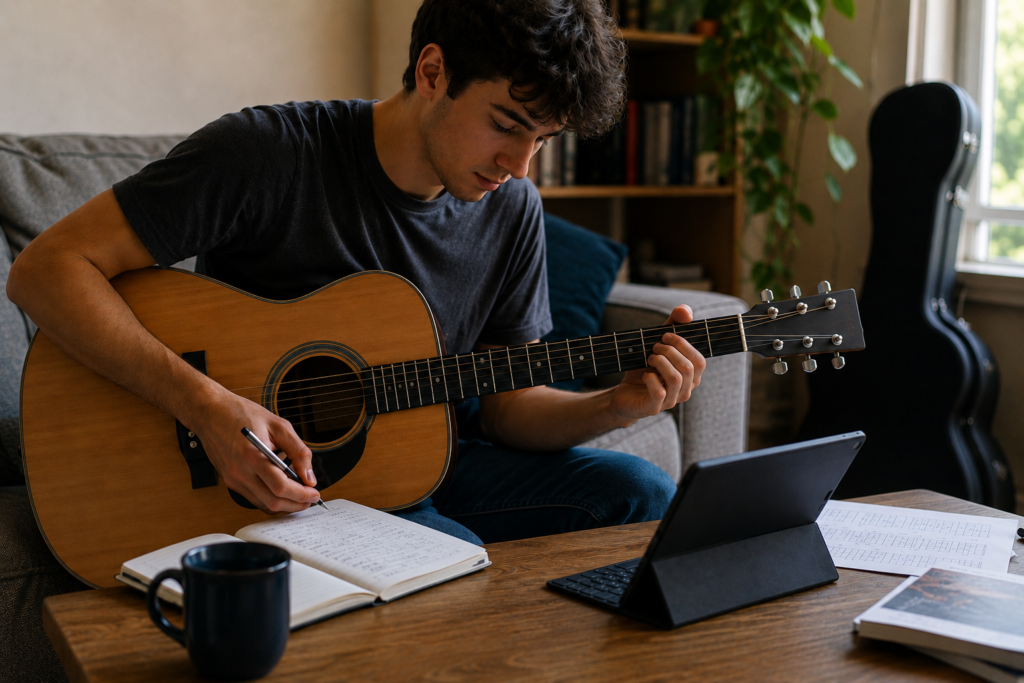
Exercises have an important purpose. They isolate a specific skill so that you can improve it without worrying about everything else happening in a song. For example, a chord-changing exercise allows you to focus entirely on moving between two chords smoothly. A picking exercise helps you develop better hand coordination. A rhythm drill gives you an opportunity to improve your timing without learning new notes at the same time.
This focused practice makes learning more efficient because your attention stays on one skill. Instead of trying to solve several problems at once, you solve one problem well. That approach often leads to faster improvement.
At the same time, exercises have a limitation that students sometimes overlook. They usually remove music from the learning process. You may become better at a particular movement, but that movement still has to fit naturally into real playing. Until that happens, the skill is only partially developed.
Songs provide something that exercises cannot. They show you why a skill matters. A simple song asks you to combine several abilities at once. You must recognize chords, change between them, keep a steady rhythm, listen carefully, and maintain consistent timing. Instead of practicing isolated movements, you are learning how those movements work together to create music.
This is one reason songs tend to be more memorable than exercises. The music provides context. Rather than remembering a series of mechanical motions, you connect those motions to a melody, a rhythm, or a favorite piece of music. That connection often makes practice more enjoyable, and it also helps many students remember what they have learned.
Songs also provide a clear sense of accomplishment. Finishing a song gives students something they can share with family and friends or simply enjoy playing for themselves. Those experiences help maintain enthusiasm, especially during the early months of learning.
Although I encourage students to spend plenty of time learning songs, that does not mean exercises should be ignored. The relationship between the two is much closer than many beginners realize. Think of exercises as preparation rather than performance. A basketball player practices free throws before playing a game. A runner trains before entering a race. In the same way, guitar exercises prepare your hands and ears for the musical challenges you will encounter in songs.
The important point is that exercises should support your musical goals instead of replacing them. If you spend months practicing drills without applying those skills to real music, your progress may begin to feel disconnected from the reason you wanted to learn guitar in the first place.
Many students assume they must choose between exercises and songs, but that is usually the wrong approach. The better question is how much time each deserves. In many practice sessions, a few minutes spent on a specific exercise can make the rest of the session much more productive. If chord changes are difficult, practicing those changes before working on a song often leads to better results. If a rhythm pattern feels awkward, a short rhythm exercise can prepare you to play it more confidently in the music that follows.
Once that preparation is complete, however, it is usually helpful to return to songs. Songs allow you to combine the individual skills you have practiced into complete musical performances. They remind you that each exercise serves a larger purpose.
Students sometimes worry that learning songs means they are neglecting technique. In reality, thoughtfully chosen songs often develop technique naturally. A beginner song teaches rhythm, chord changes, listening, coordination, and musical expression all at the same time. Each new song becomes another opportunity to strengthen multiple skills together.
Exercises and songs both have an important place in learning guitar, but they do not serve the same purpose. Exercises help you improve individual skills, while songs teach you how to use those skills to make music. Over the years, I have found that students stay motivated longer when they regularly experience the satisfaction of playing complete songs. They still benefit from focused exercises, but those exercises become stepping stones rather than the final goal.
If you ever find yourself spending more time practicing drills than making music, it may be worth adjusting your approach. Keep the exercises that solve specific problems, but spend most of your practice time doing what inspired you to pick up the guitar in the first place. After all, the goal is not to become excellent at practicing exercises. The goal is to become a musician who enjoys playing songs.
About the Author
Daryl is the creator of the FretSteps Guitar Method and has over 25 years of playing and teaching experience. He helps beginner and developing guitar players learn through a structured, step-by-step approach designed to build confidence and lasting musical skills.