
One of the biggest misconceptions about learning guitar is that progress comes from simply learning more songs. It’s easy to understand why people believe this. Songs are enjoyable, recognizable, and they provide a clear sense of accomplishment. After learning a favorite riff or strumming through a familiar chorus, it feels like real progress has been made. Sometimes that’s true. However, many beginners eventually discover that they can play parts of several songs while still struggling with chord changes, rhythm, timing, or basic technique.
The reason is that songs and skills are not the same thing. Songs give you something to play, but skills give you the ability to play almost anything. A player who memorizes one difficult song has learned that song. A player who develops solid rhythm, clean fretting, accurate picking, and efficient chord changes has built abilities that transfer to hundreds of songs. Learning guitar becomes much easier when the focus shifts from collecting songs to developing the skills that make learning new music increasingly simple.
This is where a learning path becomes valuable. A learning path is more than a list of topics or a collection of exercises. It is a carefully planned sequence that introduces each new skill at the right time and builds upon what has already been learned. Instead of constantly wondering what to practice next, the student follows a progression where each lesson supports the next one. That structure creates steady improvement because every new concept has a foundation beneath it.
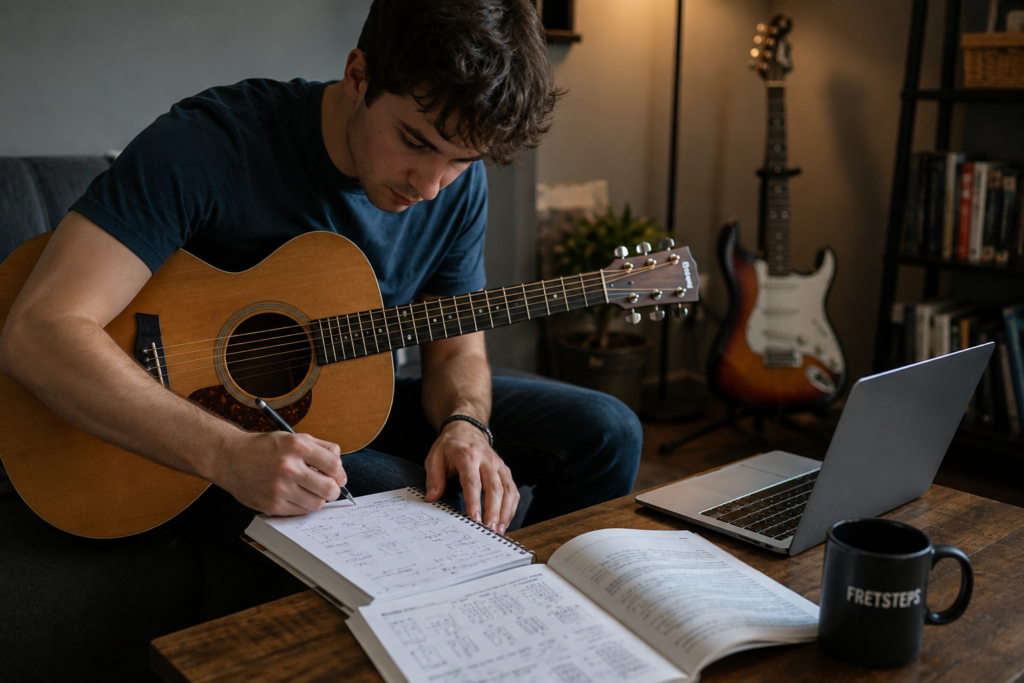
Many beginners never experience this type of progression. Instead, they search online whenever they have time to practice. One day they watch a video about power chords. The next day they decide to learn fingerstyle guitar because they found an interesting tutorial. A few days later they attempt a difficult solo because they love the song. Each lesson may be useful on its own, but together they often create a scattered approach that leaves important gaps in a player’s development.
Imagine trying to build a house without following a blueprint. You might install windows before the walls are finished or begin painting before the roof is in place. Every individual task has value, but completing them out of order creates unnecessary problems. Learning guitar works much the same way. Skills depend on one another, and skipping foundational concepts often makes later lessons much more difficult than they need to be.
A good learning path recognizes these relationships. It teaches posture before advanced technique because comfortable playing position supports everything that follows. It develops rhythm before complicated strumming patterns because timing is the foundation of music. It introduces simple open chords before barre chords because the hands need time to develop strength, flexibility, and coordination. Each lesson prepares the student for the next one, allowing improvement to happen naturally instead of through constant trial and error.
Many beginners believe that faster progress comes from learning more difficult material. In reality, the order in which you learn often matters more than the difficulty of the lesson itself. An advanced concept introduced at the wrong time can slow progress rather than accelerate it. A simpler concept taught at exactly the right moment often unlocks several new abilities at once.
Barre chords provide a good example. They’re an important part of guitar playing, but many beginners try to learn them before they have developed consistent finger strength or clean open chord technique. They spend weeks struggling with buzzing strings, sore hands, and frustration. The problem is usually not that barre chords are impossible, but that the skills supporting them have not been fully developed yet. After several months of playing open chords, strengthening the fretting hand, and improving finger independence, those same barre chords become much more manageable.
The same principle applies to lead guitar. Many players dream of playing impressive solos, so they focus almost entirely on scales and fast finger movements. At the same time, they neglect rhythm playing because it feels less exciting. Later they discover that keeping steady time with other musicians is much harder than playing individual notes. Rhythm guitar is not a beginner topic that becomes unimportant later. It remains one of the most valuable skills a guitarist can develop throughout a lifetime of playing.
This is why experienced teachers often encourage patience. They aren’t trying to slow students down. They’re trying to prevent unnecessary frustration by introducing new challenges when the student is ready to succeed. Learning the right lesson at the right time almost always produces faster long-term progress than attempting everything at once.
Another benefit of a structured learning path is that it helps students recognize progress that might otherwise go unnoticed. Learning guitar rarely happens through dramatic breakthroughs. Most improvement comes from dozens of small gains that gradually accumulate. A chord change becomes slightly smoother. A rhythm feels more consistent. A melody requires less concentration than it did the week before. Each improvement may seem insignificant by itself, but together they produce remarkable growth over time.
Without a clear progression, many students miss these improvements because their attention is constantly shifting to something completely different. They never spend enough time reinforcing one skill before moving to another. As a result, every practice session feels like starting over. A structured curriculum gives each skill enough repetition to become dependable before introducing the next challenge.
A learning path also reduces one of the most overlooked obstacles in learning guitar, which is decision fatigue. Every time you sit down to practice, you have a limited amount of focus and mental energy. If the first fifteen minutes are spent deciding what to work on, searching for videos, comparing tutorials, or wondering whether you are practicing the right thing, less energy remains for actual improvement. A structured curriculum removes those unnecessary decisions and allows you to devote your full attention to playing.
This doesn’o’t mean every guitarist should follow exactly the same path forever. Personal interests matter. One player may eventually focus on blues while another enjoys country, rock, jazz, or fingerstyle acoustic music. The purpose of a learning path isn’t to limit those choices. It’s to prepare you for them. Once your foundation is strong, exploring new styles becomes much easier because the underlying skills already exist.
Perhaps the greatest benefit of a learning path is confidence. Instead of wondering whether you are falling behind or missing something important, you know exactly what you are working toward. Each lesson has a purpose, and each practice session contributes to a larger goal. That sense of direction makes it easier to stay consistent, even during weeks when progress feels slow.
Every accomplished guitarist once stood at the beginning, facing the same questions and the same uncertainty. The players who continue improving are rarely the ones who learn the most songs in the shortest amount of time. More often, they are the ones who patiently build one skill upon another until the instrument begins to feel natural in their hands. A thoughtful learning path does not remove the work required to learn guitar, but it ensures that every hour you practice moves you in the right direction.
About the Author
Daryl is the creator of the FretSteps Guitar Method and has over 25 years of playing and teaching experience. He helps beginner and developing guitar players learn through a structured, step-by-step approach designed to build confidence and lasting musical skills.